11 Best Apollo.io Alternatives & Competitors in 2026 (Verified Pricing)
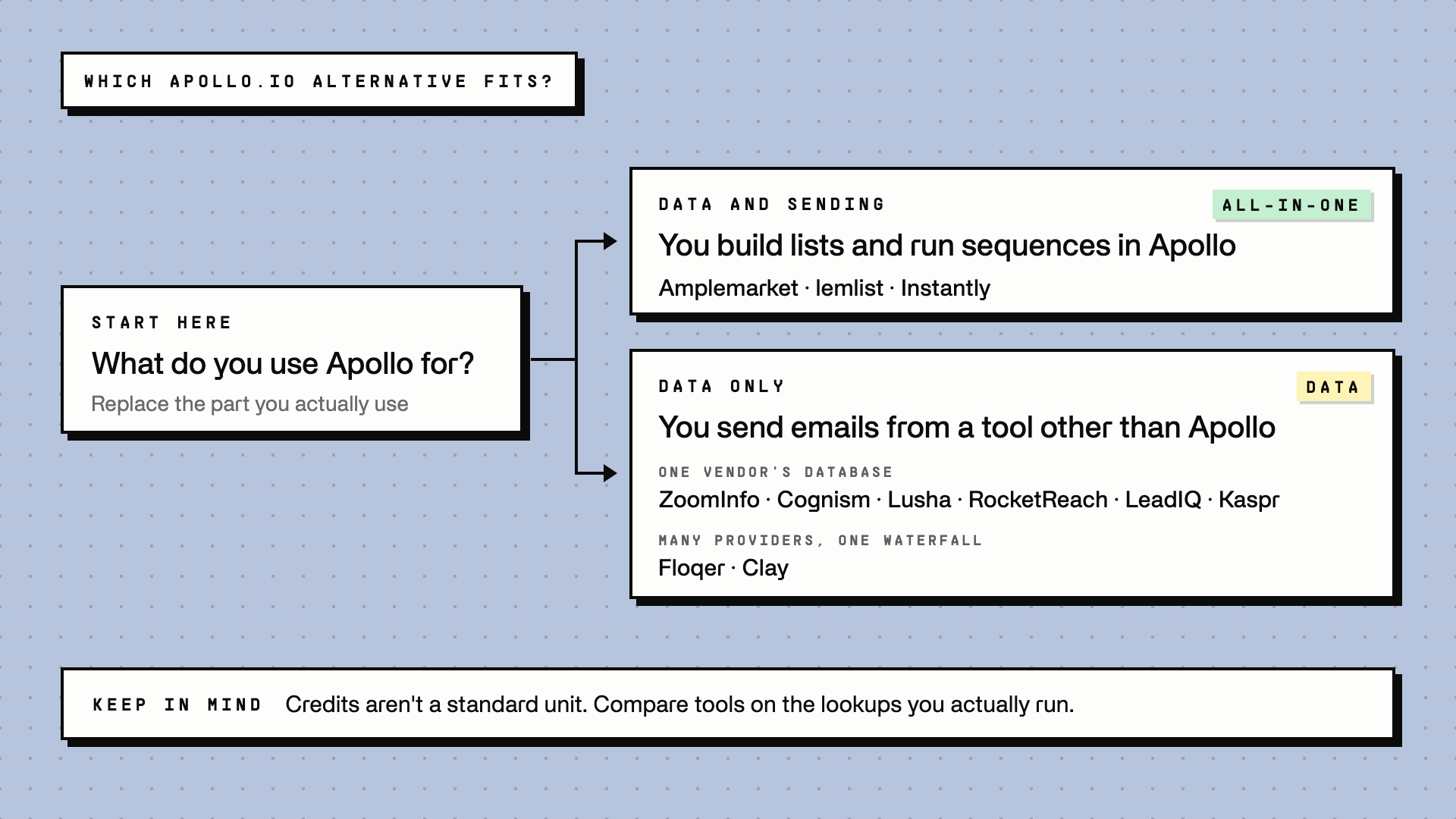
Apollo.io alternatives are tools that replace some or all of what Apollo does for prospecting and lead generation: its B2B contact database, its email sequences and dialer, or both at once. The best Apollo.io alternatives in 2026 are Floqer (from $49/month, unlimited seats) if you want more data per contact than one database holds, and Amplemarket, lemlist, and Instantly if you want data and outreach in one tool. For data alone, the main contact databases are ZoomInfo, Cognism, Lusha, RocketReach, LeadIQ, and Kaspr. Clay is the pick when you want to build your own data workflows across many providers. Every price on this page was checked on the vendor's own pricing page on November 23, 2026.
This guide covers Apollo.io, the sales intelligence and engagement platform, not Apollo GraphQL or other products named Apollo.
Last updated: November 23, 2026. Prices last verified: November 23, 2026.
Disclosure first: this is the Floqer blog, and Floqer, our product, is on this list. Its section names where it falls short against Apollo and who should not pick it. Every other tool here replaces a real part of Apollo: its database, or its database and outreach together.
In this guide
- What you're replacing when you leave Apollo
- Apollo.io alternatives compared (table)
- How we chose and verified every tool
- Why teams look for an Apollo alternative
- The 3 all-in-one Apollo alternatives: Amplemarket · lemlist · Instantly
- The 6 single-database Apollo alternatives: ZoomInfo · Cognism · Lusha · RocketReach · LeadIQ · Kaspr
- Multi-provider Apollo alternatives: Floqer · Clay
- Apollo.io vs ZoomInfo
- Free Apollo alternatives
- Cheaper Apollo alternatives
- Apollo alternatives with a Chrome extension
- Apollo alternatives for European data
- Tools that are not Apollo alternatives
- When Apollo is still the right choice
- FAQ
What you're replacing when you leave Apollo
Apollo is a sales platform with two halves. The first is data: a B2B contact and company database, a Chrome extension for LinkedIn and Gmail, and, on Basic and up, waterfall enrichment. The second is outreach and selling: email sequences, a dialer, meeting scheduling, and deal management, all in the same workspace.
That shape decides which alternative fits. If you build lists and run sequences in Apollo, you need an all-in-one replacement, or a data tool plus a sequencer. If you already send from a different tool, such as Outreach, Salesloft, or Instantly, you only need to replace Apollo's data, and there are two kinds of tool for that. A single database gives you one vendor's contacts and pricing. A multi-provider platform checks several providers in turn, so a contact one source misses can come from the next, and adds workflows on top.
Apollo's own pricing, checked on November 23, 2026:
- Free: $0, 75 credits a month, 2 sequences.
- Basic: $49 per seat a month billed annually ($65 monthly), 2,500 credits per seat a month, waterfall enrichment, 5 automated workflows.
- Professional: $79 per seat a month billed annually ($99 monthly), 4,000 credits per seat a month, AI lead scoring, call recording.
- Custom: priced by Apollo's sales team, for SSO, advanced security, and custom volumes.
An email costs 1 credit and a phone number 8. Credits are pooled across the team and expire at the end of each billing cycle.
Apollo.io alternatives compared
| Tool | Replaces | Starting price (verified 11/2026) | Best for |
|---|---|---|---|
| Floqer | Data (many providers) | Free (100 credits); $49/mo, unlimited seats | More data per contact, sent to your CRM and sequencer |
| Amplemarket | Data and outreach | $600/mo on an annual term, 2 users | An all-in-one with AI and hands-on onboarding |
| lemlist | Data and outreach | $55/mo billed yearly; lead data from $16/mo | Multichannel outreach: email, LinkedIn, calls |
| Instantly | Data and outreach | $47/mo for outreach, plus lead credits from $47/mo | High-volume cold email |
| ZoomInfo | Data (one database) | Quote-only (free trial) | Enterprise teams with a procurement process |
| Cognism | Data (one database) | Quote-only, 5 seats included | EMEA teams that call: phone-verified mobiles |
| Lusha | Data (one database) | Free (40 credits/mo); $37.45/mo billed yearly | Fast lookups from a Chrome extension |
| RocketReach | Data (one database) | $27/mo billed annually (email only); phones from $69/mo | Low-cost email and phone lookups |
| LeadIQ | Data (one database) | Free (50 credits); Pro from $15/mo | Capturing prospects from LinkedIn into your CRM |
| Kaspr | Data (one database) | Free; €59 per user/mo | European contact data from LinkedIn |
| Clay | Data (many providers) | $167/mo billed annually | Teams with a GTM engineer |
| Apollo.io (baseline) | Data and outreach | Free (75 credits/mo); $49 per seat/mo billed annually | Teams that want list building and sequences in one place |
A caveat before you compare those numbers: a credit is not a standard unit. Apollo charges 8 credits for a phone number, Cognism charges 1 credit per revealed contact, RocketReach caps exports instead of lookups, and Instantly bills its lead database separately from sending. Price each tool against the lookups you actually run, and count seats: several of these tools, like Apollo, charge per user.
How we chose and verified every tool
The inclusion test. A tool made this list only if it replaces one of Apollo's two halves with a real product: its contact database, or its database and outreach together. Sequencers with no data of their own, single-purpose email finders, and intent platforms were cut and are listed separately, with reasons.
Price verification. Every price was taken from the vendor's own pricing page on November 23, 2026. Where a vendor doesn't publish prices (ZoomInfo, Cognism, and Amplemarket's larger plans), we say so instead of quoting third-party estimates.
Vendor figures. Accuracy rates on this page are each vendor's own claims, labeled as such.
What we haven't done. We haven't run the same list through all eleven tools. When we do, the results will go on this page.
Why teams look for an Apollo alternative: 4 reasons
- Credits come with seats. Apollo prices per seat, and every seat on an account has to be on the same plan. Each seat adds credits to a shared pool, so more lookups mean more seats or add-on credits. Add-on credits renew every billing cycle until you remove them.
- Phone numbers and waterfalls use credits fast. A phone number costs 8 credits, and Apollo's waterfall charges for every source that returns data, plus each validation. Credits that go unused expire at the end of each billing cycle, including add-on credits.
- The top plan is now custom-priced. Apollo's highest tier, with SSO and advanced security, no longer has a public price, so larger teams negotiate.
- One database first. Apollo checks its own data before its partners. Teams calling into Europe, or selling to roles one database covers thinly, often add a second source anyway, and at that point some replace Apollo's data entirely.
The 3 all-in-one Apollo alternatives
These replace both halves: a lead database plus outreach in the same product. If your reps build a list and enroll it in a sequence every day, start here.
Amplemarket: the closest all-in-one, with more support
Amplemarket is an all-in-one sales platform: B2B data, multichannel sequences that combine email and social outreach, AI intent signals, an outbound dialer with parallel dialing, and an AI copilot called Duo. You can also find, enrich, and sequence leads from AI tools like Claude and ChatGPT. Plans differ mainly in contacts included, users, and support: the Startup plan comes with a scaled CSM and community onboarding, while Growth and Elite get a dedicated CSM and personalized onboarding.
Best for: teams that want Apollo's all-in-one shape with more onboarding help and AI built into the workflow.
Weaknesses: a much higher entry price than Apollo, on an annual term, and only the entry plan has a public price.
Pricing: Startup $600/month on an annual term, with 2 users and 27,000 contacts. Growth (4 users, 140,000 contacts) and Elite (10 users, 400,000 contacts) are quote-only. All plans include a free trial.
Apollo vs Amplemarket in one line: both put data, sequences, and a dialer in one place; Amplemarket costs more and includes more hands-on help.
lemlist: multichannel outreach with a lead database
lemlist pairs multichannel outreach with a lead database, plus an email and phone finder. The Multichannel plan adds LinkedIn automation, SMS, a WhatsApp add-on, and a built-in call dialer. It also ships AI agents for signals, enrichment, and messaging, and an MCP server and CLI.
Best for: teams whose outreach runs across email, LinkedIn, and calls, and who want the leads in the same tool.
Weaknesses: contact data costs extra. Emails and phone numbers come from a lead data add-on that draws on 25+ providers, and its 2,000 monthly credits buy about 400 emails or 80 phone numbers.
Pricing: Email plan $55/month billed yearly ($69 monthly), with unlimited users and 50,000 emails a month. Multichannel $87 per user a month billed yearly ($109 monthly). Lead data add-on from $16/month billed yearly ($20 monthly) for 2,000 credits a month. Enterprise is custom. Free trial.
Apollo vs lemlist in one line: Apollo leads with its database and adds sequences; lemlist leads with multichannel outreach and adds data as a paid extra.
Instantly: high-volume cold email with a lead database
Instantly is a cold email platform built for volume: unlimited email accounts and warmup on every plan, with sending limits set by plan. Its Lead Finder searches a B2B database with filters for title, seniority, company size, industry, location, and intent, and you pay only for verified leads.
Best for: teams whose outbound is mainly cold email at scale.
Weaknesses: it's built around email. The lead database is billed separately from sending, in Instantly credits, so budget for both. It has no Chrome extension.
Pricing: outreach plans at $47/month (5,000 emails, 1,000 uploaded contacts), $107/month (125,000 emails, 25,000 contacts), and $358/month (500,000 emails, 100,000 contacts), billed monthly; Enterprise is custom. Lead credits are a separate plan: $47/month for 1,500 to 2,000 credits, $97/month for 5,000 to 7,500, and from $197/month for 10,000 to 200,000; Enterprise is custom. Instantly's pricing page doesn't say what one credit buys.
Apollo vs Instantly in one line: Apollo is a sales platform with sequences; Instantly is a sending engine with a lead database next to it.
The 6 single-database Apollo alternatives
These replace Apollo's database. Pair any of them with the sequencer you already use. Most also have a Chrome extension for LinkedIn, so reps can look people up where they prospect.
ZoomInfo: the enterprise database
ZoomInfo is one of the best-known B2B data vendors, with packages for enterprise sales, marketing, and recruiting teams. Its Professional package covers contact and company profiles with mobile numbers and business emails, CRM integrations, a Chrome extension and mobile app, AI email writing, and dialing. Copilot Advanced and Copilot Enterprise add intent signals, website visitor identification, workflows, and AI account summaries. It holds ISO 27001, ISO 27701, and SOC 2 Type II certifications.
Best for: larger teams that need deep company data, intent, and a vendor that passes enterprise security reviews.
Weaknesses: no public pricing, so every deal is negotiated. It's more than most small teams need.
Pricing: quote-only; free trial available.
Apollo vs ZoomInfo in one line: Apollo is self-serve and per seat with sequences built in; ZoomInfo is sold through sales, with deeper company data and intent.
Cognism: phone-verified data for EMEA teams
Cognism sells compliance-first B2B data with phone-verified mobile numbers, built for teams that call. It offers signals for hiring, funding and M&A, and job changes, plus AI company research and MCP and API access; the Pro package adds on-demand mobile verification and intent data. CRM enrichment is an add-on. Each package includes 5 seats.
Best for: teams selling into Europe and the UK that rely on calling.
Weaknesses: no public pricing, and the 5-seat packages are sized for teams, not individuals. It's data only, so you still need a sequencer.
Pricing: quote-only, Standard and Pro packages with 5 seats included. 1 credit reveals one contact, viewing a contact you already revealed is free, and the same credits work across the platform, enrichment, and the API.
Apollo vs Cognism in one line: Apollo charges 8 credits for a phone number; Cognism charges one credit per contact and focuses on verified mobiles.
Lusha: quick lookups with a free plan
Lusha is a contact database built for fast lookups, used mostly through its Chrome extension. Paid plans add bulk and CSV enrichment, an API, signals, and webhooks, and Lusha now offers waterfall enrichment and an MCP server so assistants like Claude can search its data.
Best for: reps and small teams who want contact details in a click, with a free plan to start.
Weaknesses: the entry plans are small, at 4,800 and 7,200 credits a year, and the jump to Premium is large.
Pricing: Free (40 credits a month, 1 seat). Starter $37.45/month billed yearly (4,800 credits a year, 1 seat), Pro $52.45/month billed yearly (7,200 credits a year, 2 seats), Premium $299.95/month billed yearly (40,800 credits a year, 5 seats). Scale is custom. Paying yearly takes 25% off.
Apollo vs Lusha in one line: Lusha is the lighter, lookup-first option, without Apollo's sequences.
RocketReach: low-cost email and phone lookups
RocketReach is a lookup tool with simple published plans. Every plan includes unlimited verified emails, MCP and API access, and an export cap per year; phone numbers start on Pro. The entry plan can also send up to 500 emails a day. RocketReach says its verified emails reach 90 to 98% deliverability.
Best for: individuals and small teams that want low-cost email and phone lookups on a predictable bill.
Weaknesses: "unlimited" lookups are capped by exports, from 1,200 a year on Essentials to 20,000 on Ultimate.
Pricing: Essentials $27/month billed annually ($329 a year), emails only, 1,200 exports a year. Pro $69/month billed annually ($829 a year), adds mobile and direct phone numbers, 3,600 exports a year. Ultimate $142/month billed annually ($1,699 a year), 20,000 exports a year. Monthly billing is also available.
Apollo vs RocketReach in one line: RocketReach is cheaper for lookups alone, without Apollo's sequences or workflows.
LeadIQ: capture from LinkedIn into your CRM and sequencer
LeadIQ is built around capture: reps find prospects on LinkedIn and Sales Navigator with its Chrome extension, get emails and mobile numbers, and send them straight to Salesforce, HubSpot, Outreach, or Salesloft. It also has a power dialer and an agentic prospecting assistant called Chewie, and it is SOC 2 Type II certified.
Best for: SDR teams that already run Outreach or Salesloft and want clean data flowing into it.
Weaknesses: it's a capture tool, not a database you browse for whole lists the way you would in Apollo.
Pricing: Free (1 user, 50 credits). Pro from $15/month at its lowest credit level (2,400 credits a year), for up to 5 users; the price rises with the credits you pick. Enterprise is custom. Annual billing takes 25% off, and any plan can be tried free for 30 days.
Apollo vs LeadIQ in one line: Apollo is where reps prospect and send; LeadIQ gets prospects from LinkedIn into the tools they already use.
Kaspr: European contact data from LinkedIn
Kaspr is a LinkedIn Chrome extension with a European data focus. Paid plans add unlimited B2B emails, more phone credits, Sales Navigator support, shared team credits, and API access.
Best for: reps prospecting European contacts from LinkedIn.
Weaknesses: it's priced per user, and direct emails and phone numbers are rationed by monthly credits.
Pricing: Free (15 B2B email, 5 phone, and 5 direct email credits a month). Starter €59 per user a month (unlimited B2B emails, 100 phone credits a month, up to 12,000 exports a year). Business €99 per user a month (200 phone and 200 direct email credits a month, up to 30,000 exports a year, API). Enterprise is custom, with unlimited credits.
Apollo vs Kaspr in one line: Kaspr is a lighter, LinkedIn-first tool with stronger European coverage by its own account, and no sequences.
Multi-provider Apollo alternatives
These don't sell one contact database. They combine many data providers in a waterfall and add workflows on top.
Floqer: for teams that want more data than one database
Floqer is a GTM data and workflow platform. It builds people and company lists and enriches them through waterfall enrichment across 100+ sources, charging only for the provider that returns the result, where Apollo checks its own database first and charges for every partner source that returns data. It adds AI web agents for research, buying signals, and branching workflows with HTTP calls and webhooks that write results to your CRM. Its Chrome extension imports LinkedIn people and companies with verified emails and phone numbers, including in bulk from Sales Navigator.
Pricing is by usage, not seats: one pool of credits for the whole team, with unlimited seats and per-user credit limits and permissions on every plan, and unused credits roll over each month. A work email costs 1 credit with most providers and a mobile number from 5, at $0.0135 a credit on every monthly plan. On G2, about a quarter of Floqer's reviewers say they came from Apollo.
Best for: teams that use Apollo mainly for data and want more coverage per contact, or that have outgrown paying per seat for lookups.
Who should NOT pick Floqer: teams that want list building, email sequences, and a dialer in one tool. Floqer has no sequences or dialer of its own; it sends contacts to the sequencer you already use, such as Outreach, Salesloft, Instantly, lemlist, or Smartlead. Floqer is also younger than Apollo (founded 2024).
Pricing: free plan (100 credits); $49 to $999/month at floqer.com/pricing, with unlimited seats.
Apollo vs Floqer in one line: Apollo puts one database, sequences, and a dialer in one place, priced per seat; Floqer goes further on the data, with 100+ sources and workflows, and sends the results to your sequencer. For the full side-by-side, including where Apollo is the better choice, see Floqer vs Apollo.io.
Clay: build your own data workflows
Clay isn't a contact database. It's a spreadsheet-style workspace that runs waterfall enrichment across many data providers, adds AI research with Claygent, and pipes the results into your CRM and outbound tools. Clay also sends cold email now, with its own Sequencer on Launch and above. Our Clay alternatives guide and Clay pricing guide cover it in depth, and Floqer vs Clay compares it with Floqer.
Best for: teams with a GTM engineer or Clay operator who want more data per contact than any one database returns.
Weaknesses: Clay bills two meters, Data Credits and Actions, and CRM sync starts on Growth. It takes real time to learn. Its own Chrome extension scrapes web pages; there's no native LinkedIn extension.
Pricing: Free (1,200 Data Credits and 6,000 Actions a year, unlimited seats). Launch $167/month billed annually; Growth $446/month billed annually, which adds CRM sync.
Apollo vs Clay in one line: Apollo gives you one database and a sales workspace; Clay gives you many providers and a blank canvas to build on.
Apollo.io vs ZoomInfo
Apollo and ZoomInfo are the two tools most often compared when teams pick a B2B database. Apollo is self-serve: it publishes per-seat prices, has a free plan, and puts email sequences, a dialer, and meeting scheduling in the same workspace as its data. ZoomInfo is sold through its sales team with no public pricing, and its Copilot packages add more company detail and intent: location and hierarchy data, buyer intent signals, website visitor identification, and AI account summaries. Teams on ZoomInfo often pair it with a sequencer; Copilot Advanced exports emails to Outreach or Salesloft.
| Apollo.io | ZoomInfo | |
|---|---|---|
| Pricing | Free plan; $49 per seat a month billed annually; Custom for larger teams | Quote-only; free trial |
| Data and intent | Contact and company database, waterfall enrichment on Basic and up, intent topics and filters | Contact and company profiles with mobile numbers; intent, website visitors, and AI account summaries on Copilot packages |
| Outreach | Email sequences, a dialer, and meeting scheduling built in | AI email writing and dialing; exports to Outreach or Salesloft on Copilot Advanced |
| Best for | Self-serve teams that want data and sequences in one place | Larger teams that need deep company data, intent, and enterprise security reviews |
Free Apollo alternatives
Apollo's own free plan gives you 75 credits a month and 2 sequences. Free options on this list:
- Floqer: 100 credits, unlimited seats.
- Lusha: 40 credits a month, 1 seat.
- Kaspr: 15 B2B email, 5 phone, and 5 direct email credits a month.
- LeadIQ: 1 user and 50 credits.
- Clay: 1,200 Data Credits and 6,000 Actions a year.
- Trials: LeadIQ (30 days on any plan), and Amplemarket, lemlist, and ZoomInfo all offer free trials.
None of these replace a paid plan at real volume. They are enough to test data quality on your own contacts before you buy.
Cheaper Apollo alternatives
Apollo starts at $49 per seat a month billed annually. Floqer starts at $49 a month for the whole team, with unlimited seats. For lookups alone, RocketReach starts lower at $27 a month billed annually (emails only), and Lusha at $37.45 a month billed yearly. LeadIQ Pro starts at $15 a month at its lowest credit level, for up to 5 users. For outreach plus data, lemlist starts at $55 a month billed yearly for unlimited users, with lead data from $16 a month on top, and Instantly at $47 a month for sending, with lead credits from $47 a month on top.
Cheaper per seat doesn't always mean cheaper per lead. Compare what each tool charges for the lookups you use most, especially phone numbers.
Apollo alternatives with a Chrome extension
Apollo's Chrome extension works on LinkedIn, in Gmail, and in Salesforce. Most tools on this list have a LinkedIn extension too, with two exceptions: Instantly has no Chrome extension, and Clay's own extension pulls data from web pages into Clay tables rather than finding LinkedIn contacts. Cognism's extension also works on company websites and inside Salesforce and HubSpot. Floqer's Chrome extension imports LinkedIn people and companies with verified emails and phone numbers, including in bulk from Sales Navigator, and pushes them to your CRM.
Apollo alternatives for European data
For prospects in Europe and the UK, look at Cognism, which sells phone-verified mobile numbers and positions its data as compliance-first, and Kaspr, which focuses on European contact data. Lusha is GDPR certified by ePrivacyseal and CCPA validated by TrustArc, by its own account. Whichever you choose, ask how the vendor sources and verifies data for the countries you sell into.
Tools that are not Apollo alternatives
Sales engagement platforms (Outreach, Salesloft): they run sequences and calls for reps. Teams leaving Apollo usually pair one with a data tool from this list.
Email finders (Hunter, Findymail, and similar): they're built around finding and verifying email addresses, one job out of the many Apollo does. If you only need work emails, you can also build your own email waterfall.
Waterfall enrichment specialists (FullEnrich, BetterContact): they enrich a list you already have across several providers. They cover Apollo's enrichment, not its prospecting and outreach.
Intent and ABM platforms (6sense, Demandbase): account-level intent and advertising for marketing teams, not contact data for reps.
HubSpot data enrichment (formerly Breeze Intelligence, built on Clearbit): it fills basic contact and company fields inside HubSpot, from a single source. Our CRM data enrichment guide compares it with other approaches.
When Apollo is still the right choice
Stay on Apollo if your reps build lists and run sequences every day and value having both in one place. Its strengths are real: a large database, sequences with A/Z testing, mailbox and domain purchasing, warmup, a dialer, meeting scheduling, and deal management, with a free plan to start and self-serve pricing from $49 a seat. Most teams that leave do so over credits and seats, not the product itself.
FAQ
What is the best Apollo.io alternative? Floqer, if you use Apollo mainly for data: waterfall enrichment across 100+ sources, AI research, and workflows, with unlimited seats from $49/month. It sends contacts to your sequencer rather than sending email itself. For an all-in-one with data and outreach, Amplemarket is the closest match, with lemlist for multichannel outreach and Instantly for high-volume cold email. For data alone, ZoomInfo suits enterprise teams, Cognism suits teams calling into Europe, and Lusha and RocketReach suit smaller budgets.
Who are Apollo.io's main competitors? In sales intelligence: ZoomInfo, Cognism, Lusha, RocketReach, LeadIQ, and Kaspr. In all-in-one prospecting and outreach: Amplemarket, lemlist, and Instantly. In data enrichment and workflows: Floqer and Clay.
What tools are similar to Apollo.io? The tools most like Apollo.io pair a contact database with outreach in one product: Amplemarket, lemlist, and Instantly. If you mean a place to look up emails and phone numbers, Lusha, RocketReach, LeadIQ, and Kaspr are the closest lookup tools, with ZoomInfo and Cognism for larger teams. Floqer and Clay go further on data, combining many providers in one waterfall.
Is Apollo.io free? Apollo has a free plan with 75 credits a month and 2 sequences. Paid plans start at $49 per seat a month billed annually ($65 monthly) on Basic, with 2,500 credits per seat a month. A 14-day trial is available on paid plans.
Is there a free Apollo alternative? Floqer (100 credits, unlimited seats), Lusha (40 credits a month), Kaspr (15 email and 5 phone credits a month), LeadIQ (50 credits), and Clay (1,200 Data Credits a year) all have free plans. They're enough to test data quality, not to replace a paid plan at volume.
What is the cheapest Apollo alternative? For lookups, RocketReach starts at $27 a month billed annually (emails only), and LeadIQ Pro from $15 a month for up to 5 users. For a whole team, Floqer starts at $49 a month with unlimited seats, where Apollo's $49 is per seat. For data plus outreach, Instantly's sending plans start at $47 a month, with lead credits from $47 a month on top. Compare cost per lookup, not just plan price.
How do Apollo credits work? Credits come with each seat and are pooled across the team: 2,500 per seat a month on Basic and 4,000 on Professional. An email costs 1 credit, a phone number 8, and enrichment 1 to 8. Credits expire at the end of each billing cycle, and add-on credits renew every cycle until you remove them.
Apollo.io vs ZoomInfo: what's the difference? Apollo is self-serve and priced per seat, with sequences built in. ZoomInfo replaces Apollo's data half, with deeper company data and intent, sold through its sales team with no public pricing. Its packages center on data, intent, and AI, and Copilot Advanced exports emails to Outreach or Salesloft, so teams often pair it with one of those sequencers.
Apollo.io vs Clay: what's the difference? Apollo is one database with a sales workspace around it. Clay doesn't have its own contact database; it combines many providers in a waterfall and lets you build custom workflows. It also has its own email Sequencer now. It suits teams with someone to build and maintain those workflows.
Can one tool replace Apollo, ZoomInfo, and Clay? For data, mostly yes. A platform that combines many providers in a waterfall, such as Floqer or Clay, checks one provider after another until it finds the contact, so you don't need a separate subscription to each database. For sending, you still need sequences: Apollo's own, an all-in-one like Amplemarket or lemlist, or a sequencer such as Outreach, Salesloft, or Instantly. Clay now has its own Sequencer; Floqer sends contacts to the sequencer you already use.
Which Apollo alternative is best for European contacts? Cognism, for phone-verified mobiles and compliance-first data, and Kaspr, for European contact data from LinkedIn at a lower price.
Does Floqer replace Apollo? Partly. Floqer replaces Apollo's data side, with lists, waterfall enrichment across 100+ sources, and a Chrome extension, on usage pricing with unlimited seats. It doesn't have Apollo's sequences or dialer: it sends contacts to your sequencer instead. See Floqer vs Apollo.io for the full comparison.
Published by the Floqer team.
We build one of the tools on this list. Every price above was checked on the vendor's own pricing page on November 23, 2026. Accuracy figures are each vendor's own claims.