Clay Pricing 2026: Plans, Data Credits, Actions, and What It Really Costs
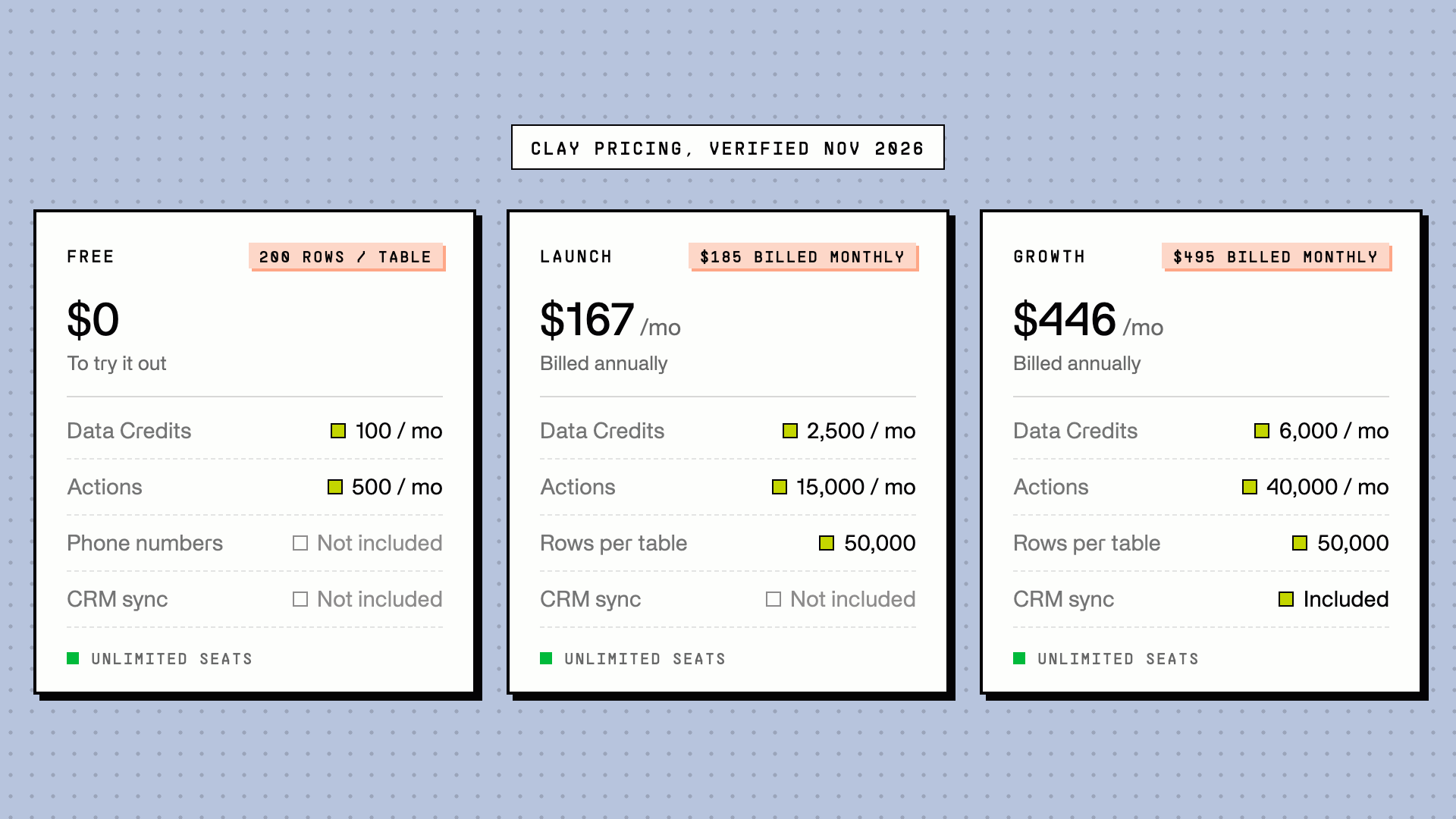
Clay pricing (for clay.com, the GTM data and workflow platform) has four plans: Free ($0), Launch ($185 a month, or $167 a month billed annually), Growth ($495 a month, or $446 billed annually), and a custom-priced Enterprise plan. Every plan bills two separate meters: Data Credits, which pay for data and AI from third-party providers, and Actions, which count each record Clay enriches or sends to another tool. Your real cost depends on how many rows you enrich, which providers you use, and whether you need CRM sync, which starts on Growth.
Last updated: November 17, 2026. Every Clay figure below comes from Clay's own pricing page and documentation, checked on that date.
Disclosure: Floqer competes with Clay. This guide is about Clay's pricing, and one clearly labeled section at the end shows where Floqer fits. Everything else applies whether or not you ever look at Floqer.
In this guide
- Clay pricing plans at a glance
- Clay credits explained: Data Credits vs Actions
- How many credits Clay uses per enrichment
- What Clay really costs per lead: 3 worked examples
- Clay pricing calculator: estimate your bill
- Rollover, top-ups, and running out
- What each plan includes, and what it gates
- Clay legacy pricing, and who kept it
- Hidden costs to budget for
- Where Clay's own pages disagree
- How to lower your Clay bill
- Is Clay worth it?
- Where Floqer fits
- FAQ
Clay pricing plans at a glance (2026)
| Plan | Monthly billing | Annual billing (per month) | Data Credits | Cost per Data Credit | Actions | CRM sync |
|---|---|---|---|---|---|---|
| Free | $0 | $0 | 100 / month | Free | 500 / month | No |
| Launch | $185 | $167 | 2,500 / month | $0.050 ($0.045 annual) | 15,000 / month | No |
| Growth | $495 | $446 | 6,000 / month | $0.048 ($0.044 annual) | 40,000 / month | Yes |
| Enterprise | Custom, annual commitment | Custom | 100,000+ / month | Custom, with volume discounts | 100,000+ to 200,000+ / month | Yes |
Four things to know before you read the table as a price list:
- The headline price is the annual one. Clay's pricing page defaults to annual billing, which saves 10%. On monthly billing, Launch is $185 and Growth is $495.
- Each plan price is two prices added together. Launch's $185 is $60 for 15,000 Actions plus $125 for 2,500 Data Credits. Growth's $495 is $205 for 40,000 Actions plus $290 for 6,000 Data Credits. You can raise either meter on its own (see the ladders below).
- Cost per Data Credit is the credit part of the price. Launch's $125 for 2,500 credits is $0.050 each. Divide the whole plan price by its Data Credits instead, and Launch works out to $0.074 per credit ($0.067 annual) and Growth to $0.083 ($0.074 annual), because part of every plan pays for Actions and features. Actions themselves cost $0.004 each on Launch and $0.005 on Growth.
- Seats are not the cost driver. Every plan includes unlimited seats and tables. You pay for usage and for features.
Clay also offers a 14-day free trial with 1,000 Data Credits, which includes CRM integrations, webhooks, and HTTP API access. Phone number enrichment is not available on the trial or the Free plan.
Clay credits explained: Data Credits vs Actions
Clay changed its pricing on March 11, 2026, splitting usage into two meters. In Clay's words, "Actions measure the orchestration you do" and "Data Credits are used to buy data or AI from 3rd party vendors."
What uses Data Credits
Data Credits pay for what a provider returns: an email address, a phone number, a LinkedIn profile, a company profile, or an AI answer. Each provider in Clay's marketplace sets its own price per result, so the same field can cost very different amounts depending on which provider finds it. Data Credits start at $0.05 each on Launch.
If you connect your own API key for a provider, that provider's lookups use no Data Credits. You pay the provider directly instead.
What uses Actions
Actions, which many users call action credits, are the meter Clay added in March 2026. Clay's rule is short: "Each record enriched or exported counts as 1 Action, regardless of data source or provider." In practice, that means one Action for every:
- Enrichment step that runs on a record (one Action per record, per enrichment column)
- AI prompt, including Claygent research
- Record you send to another tool, such as a CRM, an ad platform, or a sequencer
- Lookup that runs on your own API key (no Data Credit, but still one Action)
Clay says each Action "costs a few tenths of a penny." At list prices that is $0.004 per Action on Launch's entry tier and about $0.005 on Growth's.
What's free
Clay doesn't charge an Action for sourcing lists of companies or people (for example, Find People returning 100 contacts), importing records from your CRM, or running formulas and filters.
The practical upshot: a workflow with five enrichment steps costs five Actions per row on top of whatever Data Credits each step uses. On small runs, the Actions are noise. On a 10,000-row campaign with several steps, they decide which plan you need.
How many credits does Clay use? Cost per enrichment
Clay's own guidance is that "each fully enriched record typically costs 6–20 Data Credits," depending on the data you want ("emails are cheap, phone numbers are expensive") and the providers you pick. These are the per-step rates Clay publishes:
| Step | Data Credits | Actions | Source |
|---|---|---|---|
| Find people from Clay's database | 0 | 0 | Clay's worked example |
| Enrich a LinkedIn profile | 0.5 | 1 | Clay's worked example |
| Find a work email (Clay's example rate) | 0.5 per email found | 1 | Clay's worked example |
| Find a work email with Prospeo on Clay's account | 2 | 1 | Clay's Prospeo integration page |
| Claygent web research, Helium model | 1 | 1 | Clay's AI pricing docs |
| Claygent web research, Argon model | 3 | 1 | Clay's AI pricing docs |
| Advanced reasoning models (about 20% of models) | Actual cost, 0% markup | 1 | Clay's AI pricing docs |
| Any lookup on your own API key | 0 | 1 | Clay's pricing page |
| Push a record to your CRM | 0 | 1 | Clay's Actions docs |
Two rows for the same job (finding an email) show why there's no single "cost per lead" for Clay: the provider sets the price. Check the credit cost on each provider's step before you add it to a table.
Claygent and AI pricing
Every AI prompt in Clay, including Claygent research, counts as one Action. The Data Credit side comes in two forms:
- Fixed pricing covers about 80% of models, including all of Clay's own (Neon, Helium, and Argon). You see the exact cost before you run. Claygent research costs 1 Data Credit per run on Helium and 3 on Argon.
- Variable pricing covers the other 20%, the most advanced reasoning models. Clay bills the actual cost of each run "with 0% markup," refunding any surplus, so you only know the price after the run.
What Clay really costs per lead: 3 worked examples
These examples use Clay's published rates from the table above and its list prices on monthly billing. They assume every lookup returns a result, which is the most expensive case for Data Credits.
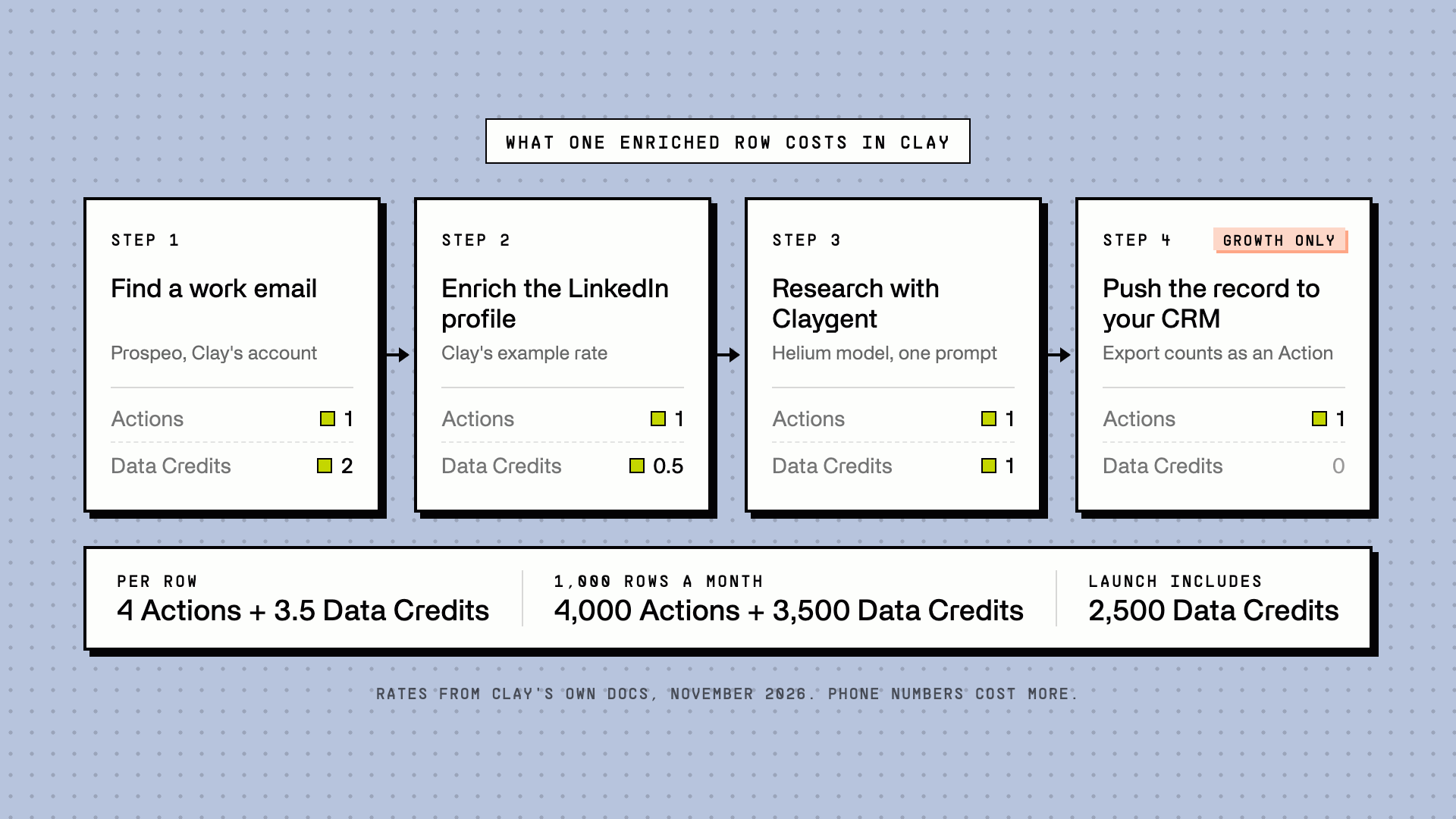
Example 1: a small team enriching 500 new leads a month
Each lead gets a work email (2 Data Credits), a LinkedIn profile (0.5), and one Claygent research question (1), then goes out as a CSV.
| Per lead | 500 leads | |
|---|---|---|
| Data Credits | 3.5 | 1,750 |
| Actions | 3 | 1,500 |
Plan: Launch, $185 a month ($167 billed annually). It includes 2,500 Data Credits and 15,000 Actions, so this team uses 70% of its credits and 10% of its Actions. The effective cost is about $0.37 per lead, and most of that is the plan floor, not usage.
Example 2: 1,000 inbound leads a month, synced to your CRM
Same three enrichment steps, plus one push to HubSpot or Salesforce per lead.
| Per lead | 1,000 leads | |
|---|---|---|
| Data Credits | 3.5 | 3,500 |
| Actions | 4 | 4,000 |
Plan: Growth, $495 a month ($446 billed annually). The usage would almost fit Launch with a credit top-up, but Launch doesn't include CRM sync, so the CRM requirement alone decides the plan. Growth includes 6,000 Data Credits and 40,000 Actions, so this team uses 58% of its credits and 10% of its Actions. The effective cost is about $0.50 per lead.
Example 3: a 10,000-row outbound campaign, synced to your CRM
The same four steps per row, run on a full campaign list in one month.
| Per row | 10,000 rows | |
|---|---|---|
| Data Credits | 3.5 | 35,000 |
| Actions | 4 | 40,000 |
Plan: Growth with a bigger credit tier, about $2,330 a month. That is $205 for 40,000 Actions plus $2,125 for 50,000 Data Credits per month ($2,098 a month on annual billing). Two catches:
- The Actions land exactly on the limit. One extra enrichment column, or a single re-run of one step, pushes the campaign past 40,000 Actions. Actions can't be bought as top-ups, so the fix is the next Actions tier: 60,000 for $290 a month.
- Phone numbers change everything. Clay says phone numbers are the expensive part of a record. Its Findymail page lists a mobile phone lookup at 9 Data Credits, which would add up to 90,000 Data Credits to this campaign if every lookup found a number. That page predates the March 2026 changes, so check the current rate in your workspace.
Clay itself positions Growth for teams enriching 1,000 to 10,000 records a month, and Enterprise above that.
Clay pricing calculator: estimate your bill before you run it
Your Clay bill comes down to two monthly totals: Actions and Data Credits. These five steps turn your row count into a plan and a price.
- List the steps each row will go through. For each one, note the Data Credits on the provider's step (shown in Clay when you add it) and count one Action per enrichment, AI prompt, or export.
- Multiply by the rows you'll run each month. Add 15 to 20% for testing and re-runs. Changing a setting on a column can re-run it across the whole table.
- Size the Actions tier first. You can top up Data Credits but not Actions, so the Actions total sets your minimum tier.
- Then size the Data Credits tier. Compare the cost of the next credit tier against topping up at a 30% premium.
- Check the features you need. CRM sync, HTTP API calls, webhooks, and web intent signals all require Growth, whatever your usage.
What the bigger tiers cost
Clay lets you raise each meter separately. Monthly prices from Clay's pricing page, verified November 17, 2026:
| Actions per month | Launch | Growth |
|---|---|---|
| 15,000 | $60 | n/a |
| 40,000 | $150 | $205 |
| 60,000 | $200 | $290 |
| 100,000 | $290 | $450 |
| 200,000 | $540 | $850 |
| Data Credits per month | Price | Per credit |
|---|---|---|
| 2,500 | $125 | $0.050 |
| 6,000 | $290 | $0.048 |
| 10,000 | $460 | $0.046 |
| 20,000 | $880 | $0.044 |
| 50,000 | $2,125 | $0.043 |
Your plan price is one row from each table, added together. Annual billing takes about 10% off both. Clay's billing docs list Launch with 2,500 to 10,000 Data Credits a month and Growth with 6,000 to 100,000, so the largest credit tiers may require Growth.
Do Clay credits roll over? Rollover, top-ups, and running out
| Data Credits | Actions | |
|---|---|---|
| Rollover, monthly plans | Up to one month's credits carry over, so your balance tops out at 2x your monthly allowance | None. Unused Actions expire at the end of each billing cycle |
| Rollover, annual plans | 15% of unused annual credits, if you renew on the same or a higher tier | None |
| Running out | Buy a one-time top-up at a 30% premium, or move to a bigger credit tier | No top-ups. You must upgrade to a higher Actions tier |
| Free plan | No rollover, no top-ups | No rollover, no top-ups |
On annual plans, Clay gives you all your credits up front instead of monthly.
The asymmetry matters for planning. A Data Credit shortfall costs you a 30% premium. An Actions shortfall costs you a tier jump, which can be a larger step than the overage itself.
What each Clay plan includes, and what it gates
| Feature | Free | Launch | Growth | Enterprise |
|---|---|---|---|---|
| Seats and tables | Unlimited | Unlimited | Unlimited | Unlimited |
| Rows per table | 200 | 50,000 | 50,000 | Unlimited bulk enrichment |
| Multi-provider waterfalls | Yes | Yes | Yes | Yes |
| Claygent (AI web research) | Yes | Yes | Yes | Yes |
| Phone number enrichment | No | Yes | Yes | Yes |
| Job change and other signals | No | Yes | Yes | Yes |
| Scheduled recurring runs | No | Yes | Yes | Yes |
| CRM auto-sync and enrichment | No | No | Yes | Yes |
| HTTP API integrations | No | No | Yes | Yes |
| Webhook automation | No | No | Yes | Yes |
| Web intent signals | No | No | Yes | Yes |
| Ad audiences (LinkedIn and Meta) | No | No | Yes | Yes |
| Clay API access, data warehouse syncs | No | No | No | Yes |
| SSO, RBAC, SCIM | No | No | No | Yes |
| Credit top-ups | No | +30% premium | +30% premium | Custom price |
The line that decides most purchases is CRM sync. Launch costs $185 a month and Growth $495, so connecting Clay to HubSpot or Salesforce adds $310 a month before you enrich a single extra row.
Clay Free plan
$0, with 100 Data Credits and 500 Actions a month, up to 200 rows per table, multi-provider waterfalls, and Claygent. No phone numbers, CRM sync, rollover, or top-ups. It's enough to learn Clay, not to run a workflow in production.
Clay Launch plan
$185 a month, or $167 billed annually, with 2,500 Data Credits and 15,000 Actions. It adds phone numbers, job change and other signals, scheduled runs, and credit top-ups. Clay positions it for teams enriching fewer than 1,000 records a month. It doesn't include CRM sync, HTTP API integrations, or webhooks.
Clay Growth plan
$495 a month, or $446 billed annually, with 6,000 Data Credits and 40,000 Actions. It adds CRM auto-sync, HTTP API integrations, webhooks, web intent signals, and ad audiences on LinkedIn and Meta. Clay positions it for teams enriching 1,000 to 10,000 records a month. Both meters scale up: Actions to 200,000 a month and, per Clay's billing docs, Data Credits to 100,000.
Clay Enterprise pricing
Custom, with an annual commitment. Clay doesn't publish Enterprise prices. The plan starts at 100,000+ Data Credits and 100,000 to 200,000+ Actions a month (Clay's pages give both figures), and adds Clay API access, data warehouse syncs, unlimited row bulk enrichment, SSO, RBAC, SCIM, credit budgeting, volume discounts on Data Credits, and a dedicated growth strategist. Clay positions it for teams enriching 10,000+ records a month.
Clay legacy pricing: how the old plans worked, and who kept them
Before March 11, 2026, Clay had one meter: credits. Data lookups and AI calls used credits, and orchestration was free. Running an HTTP call, pushing a record to your CRM, or using a provider on your own API key cost nothing on Clay's side. As Clay's pricing page put it at the time, if you already paid for a provider, "you can still use them on Clay for free!"
The legacy plans and what they cost
From Clay's pricing page as archived on February 17, 2026, the last version before the change:
| Legacy plan | Monthly billing | Annual billing (per month) | Credits per month | Cost per credit | Features added at this tier |
|---|---|---|---|---|---|
| Free | $0 | $0 | 100 | n/a | Claygent, exports |
| Starter | $149 to $229 | $134 to $206 | 2,000 to 3,000 | About $0.075 | Phone numbers, your own API keys, scheduling, signals |
| Explorer | $349 to $699 | $314 to $629 | 10,000 to 20,000 | About $0.035 | HTTP API, webhooks, email sequencing integrations |
| Pro | $800 to $2,000 | $720 to $1,800 | 50,000 to 150,000 | About $0.013 to $0.016 | CRM integrations, web intent |
| Enterprise | Custom | Custom | Custom | Custom | Unlimited rows, Snowflake, SSO |
Two things defined the old model. Volume discounts were steep: Clay advertised its Pro plan as "up to 7x cheaper than our starter plan" per credit. And CRM integrations started at Pro, $800 a month, so the modern Growth plan at $495 is a cheaper way into CRM sync for most teams.
The March 2026 pricing change
On March 11, 2026, Clay replaced its legacy plans with Launch and Growth and the two-meter model. Clay's announcement said it was "reducing the cost of data in our marketplace by 50–90%." The trade: data got cheaper per lookup, and orchestration got its own meter.
How existing customers kept legacy pricing
Clay didn't force existing subscribers onto the new model. Its legacy plan docs set out the rules:
- March 11, 2026: new customers move to the new plans. Existing customers could stay put: "If you're on a legacy plan and choose to stay on it, you'll keep your familiar pricing and all the features you have today."
- April 10, 2026: the window to change legacy plans closed. Until then, legacy customers could still move between legacy plans. After April 10, 2026 at 11:59pm PDT, "any plan change forces migration to modern plans," and you can't switch between legacy plans or come back to one. Need more credits, fewer credits, or a different tier? That now means moving to the new pricing.
- No end date, but no promises either. Clay says legacy plans "will be supported for the foreseeable future with bug fixes, security updates, and quality of life improvements," and that it "may sunset legacy plans in the long term." Legacy Enterprise is no longer sold, and existing legacy Enterprise workspaces are grandfathered indefinitely.
- No cheaper data on legacy. The 50% data price cut only applies to modern plans. Clay's rule of thumb: if you're charged for Actions, you're on new pricing.
- New features on a trial until December 31, 2026. Legacy Starter, Explorer, and Pro plans include Audiences, Workflows, Sequencer v2, and MCP, CLI, and API access at no extra cost through December 31, 2026. After that, most step down to their free-plan versions (MCP, CLI, and API included). Clay Ads was never part of the trial, and there's no paid add-on to keep these features on a legacy plan.
Extensions for some agencies and customers
The published rules aren't the whole story. Clay users have told us that Clay has extended legacy pricing for some agencies and customers as a way to keep their business. Clay doesn't publish these exceptions or their terms, so we can't say how common they are or who qualifies.
If you're on a legacy plan, or you're an agency running several, ask your Clay contact what's possible before you change anything. A self-serve plan change migrates you for good.
Legacy vs modern pricing: Clay's own comparison
| Legacy plans | Modern plans | |
|---|---|---|
| Usage meters | Credits only | Actions + Data Credits |
| Charges for orchestration | None | Actions, about 15% of a credit's cost |
| Data cost in credits | Higher | 50% cheaper on 70+ enrichments |
| Top-up premium | 50% | 30% |
| Cost per credit, entry tier | About $0.07 to $0.08 (Starter) | About $0.05 (Launch) |
| Cost per credit, higher tier | About $0.012 to $0.016 (Pro) | Lower with enrichment discounts (Growth) |
| HTTP API and webhooks | Explorer and up | Growth and up |
| CRM integrations | Pro and up | Growth and up |
Should you stay on a legacy plan?
Stay if your workflows lean on your own API keys or HTTP calls (no Action charge on legacy), you're on Explorer or Pro with cheap credits, your usage fits your current plan, and you don't need the new features after December 31.
Move if most of your spend is data lookups that got cheaper, your usage no longer fits your plan (any change migrates you anyway), or you want Audiences, Workflows, Clay Ads, or new integrations.
Before deciding, run last month's usage through both models: credits as you used them on legacy, versus the new Data Credit rates plus one Action per enrichment and export.
Hidden costs to budget for
- Actions on your own API keys. Bringing your own key saves Data Credits but still costs one Action per run. Before March 2026, it cost nothing on Clay's side.
- AI with variable pricing. About 80% of Clay's AI models have a fixed price you see before running. The other 20%, the most advanced reasoning models, bill the actual cost of each run, which you only see after it finishes.
- Re-runs and test runs. Every re-run bills again. One Clay user on G2 reported spending a month's credits by changing a single setting that re-ran a whole workbook. Turn off auto-run while you build.
- The plan floor for features. CRM sync, HTTP APIs, and webhooks start at Growth's $495 a month.
- Tier jumps for Actions. Because Actions can't be topped up, an Actions overage costs a whole tier.
- The 50,000-row table limit. Launch and Growth cap each table at 50,000 rows. Bigger lists mean splitting tables, or Enterprise's unlimited bulk enrichment.
- The time to build. Clay is powerful and has a real learning curve. Most teams that use it fully have a GTM engineer or Clay operator who owns the tables.
Where Clay's own pages disagree
While checking every figure for this guide, we found places where Clay's pages contradict each other. Until Clay reconciles them, test before you rely on either version:
- Whether failed lookups are charged. The pricing page says: "If an enrichment returns no result, you're not charged Data Credits or Actions." Clay's credit refunds doc says: "Many actions charge whether or not the provider finds a match, because the provider charges Clay either way," and lists the exceptions. It also notes that an "invalid" email verification result is a real answer, so it's charged.
- What finding an email costs. Clay's worked example uses 0.5 Data Credits per email. Its Prospeo integration page charges 2 credits per enriched cell on Clay's account. Both can be true, because the provider sets the price.
- Credit limits on Launch. The pricing page lets you pick up to 50,000 Data Credits a month. Clay's billing docs say Launch covers 2,500 to 10,000.
- Enterprise Actions. The pricing page says Enterprise includes 200,000+ Actions a month. Clay's billing docs say 100,000+.
How to lower your Clay bill
- Test on 10 to 50 rows first, and keep auto-run off until the table is right.
- Order waterfall providers cheapest first, so the expensive ones only run when the cheap ones miss.
- Use run conditions ("only run if") so a step skips rows that already have the value or don't match your ICP.
- Filter accounts before you enrich contacts. Enriching people at companies you'll never sell to is the most common waste.
- Use fixed-price AI models for research, and save the advanced, variable-price models for the final step that needs them.
- Bring your own keys for providers you already pay. It saves Data Credits, but budget one Action per run.
- Count Actions per row before a big run. A step you don't need costs one Action on every row.
- Pay annually if your usage is steady. It saves 10%, and the credits arrive up front.
- Keep your legacy plan if the math favors it. Any plan change forfeits it for good.
Is Clay worth it?
Clay is worth it when a dedicated operator uses its flexibility: multi-provider waterfalls, Claygent research at scale, and custom workflows across 150+ data providers. Teams in that position typically run 1,000 or more records a month and treat Clay as core infrastructure, so the plan floor matters less than the output.
It's harder to justify when:
- Your volume is low. At 500 leads a month, the plan floor makes up most of the bill.
- You need CRM sync at small scale. That's $495 a month on monthly billing, however few records you push.
- Nobody owns it. Without an operator, tables go stale and re-runs waste credits.
- Your workflows are mostly your own API keys or HTTP calls. Clay's Data Credits stop mattering, and Actions become a second bill for the same work.
Clay pricing for agencies
Agencies feel the March 2026 change most, because their margin depends on running the same workflows across many clients.
- Pricing is per workspace, with unlimited seats. Clients can join a workspace at no cost, but every credit and Action comes out of that workspace's plan.
- Actions cap campaign size. A 10,000-row campaign with four steps per row uses all 40,000 Actions on Growth's entry tier. Running several clients at that size means a higher Actions tier or Enterprise, and Actions can't be topped up between campaigns.
- Your own API keys no longer make orchestration free. Each run on an agency's own provider keys still costs one Action.
- Some agencies kept legacy pricing. Clay users have told us Clay extended legacy pricing for some agencies (see extensions for some agencies and customers).
- Decide who holds the account. If each client has its own workspace, the client carries the plan floor and the risk of running out. If the agency holds one workspace, it carries both, and per-group credit budgets are an Enterprise feature.
If Clay's pricing doesn't fit your team, our guide to Clay alternatives compares nine tools with pricing verified in November 2026.
Where Floqer fits
Floqer is a GTM data and workflow platform in the same category as Clay: waterfall enrichment across 100+ sources, AI web research agents, and workflows that write back to your CRM. The pricing models are built differently, so here is how they compare, including where Clay comes out ahead.
| Clay | Floqer | |
|---|---|---|
| Usage meters | Two: Data Credits and Actions | One: credits, spent only when a step looks up new information |
| Moving data (CRM writes, exports, formatting) | 1 Action per record enriched or exported. Formulas and filters are free | Free: integrations, formatting, merging lists, and exports to your CRM or outreach tools |
| Entry paid plan | $185/month ($167 annual): 2,500 Data Credits + 15,000 Actions | $49/month: 3,630 credits |
| CRM sync | Growth and up, from $495/month ($446 annual) | Every paid plan, from $49/month |
| HTTP APIs and webhooks | Growth and up | Every paid plan |
| Rows per table | 50,000 on Launch and Growth | 500,000 on self-serve |
| Rollover | Data Credits: up to one month's (monthly) or 15% (annual). Actions never roll over | Unlimited while subscribed, and valid for 12 months after |
| Top-ups | Data Credits at a 30% premium. Actions can't be topped up | At the same rate or better |
| Repeat lookups | Billed again. Reusing data your workspace already bought is an opt-in beta that's still rolling out | Free when the same data was already enriched on Floqer |
| Seats | Unlimited | Unlimited |
| Free plan | 100 Data Credits, 500 Actions, 200 rows per table | 100 credits |
Where Clay is ahead:
- More providers. Clay lists 150+ data providers. Floqer has 100+.
- A bigger community. Clay has a larger template library, and there's more material from Clay users to reference.
- Meta ad audiences. Clay pushes audiences to LinkedIn and Meta on Growth. Floqer syncs to Google Ads and LinkedIn Ads, but not yet to Meta.
Cost per work email: Clay vs Floqer
Both on monthly billing. Floqer charges the same rate per credit on every plan, from $49 to $999 a month.
| Clay (Launch, monthly) | Floqer (any monthly plan) | |
|---|---|---|
| Price per credit | $0.050 per Data Credit | $0.0135 per credit |
| Credits per work email found | 0.5 (Clay's worked example) | 1 at most |
| Credit cost per work email | $0.025 | $0.0135 at most |
| Actions per work email | 1 ($0.004) | None |
| Total per work email | $0.029 | $0.0135 at most |
Clay's credit cost per email depends on the provider. This table uses Clay's own example rate of 0.5 Data Credits per email. Floqer pricing, with unlimited seats on every plan, is at floqer.com/pricing.
Sources and method
Every Clay price, limit, and rate in this guide comes from Clay's own pages, checked on November 17, 2026: the pricing page, Actions and Data Credits, plans and billing, AI pricing, legacy plans, credit refunds, Clay's pricing memo, and the Prospeo and Findymail integration pages. The worked examples are our arithmetic on those published rates. Per-credit and per-Action prices are list price divided by volume. Clay changes its pricing often, so confirm on its pricing page before you buy.
FAQ
How much does Clay cost? Clay has a free plan, Launch at $185 a month ($167 billed annually), Growth at $495 a month ($446 billed annually), and custom-priced Enterprise. Those are entry prices: you can raise the Actions and Data Credits on each plan separately, and a 10,000-row campaign with CRM sync can cost over $2,000 a month.
Is Clay free? Clay has a free plan and a free trial, both limited. The Free plan includes 100 Data Credits and 500 Actions a month, up to 200 rows per table, and Claygent, but no phone numbers or CRM sync. The 14-day free trial includes 1,000 Data Credits plus CRM integrations, webhooks, and HTTP API access, but not phone number enrichment.
What's the difference between Clay Data Credits and Actions? Data Credits pay for data and AI from third-party providers, like an email address or a Claygent answer. Actions count the orchestration: each record enriched or exported uses one Action, regardless of provider. Most steps use both.
What are Clay action credits? "Action credits" is what many users call Clay's Actions, the second meter Clay added in March 2026. Each record enriched or exported uses one Action, including lookups on your own API keys. Launch includes 15,000 a month and Growth 40,000. Unlike Data Credits, Actions can't be topped up and don't roll over.
How much does one Clay credit cost? Data Credits start at $0.05 each on the entry tier and fall to about $0.043 at 50,000 a month. One-time top-ups cost 30% more. Actions cost a few tenths of a penny each, about $0.004 on Launch and $0.005 on Growth at entry tiers.
How many Clay credits does one lead use? Clay says a fully enriched record typically uses 6 to 20 Data Credits, plus one Action per enrichment step and export. A work email costs 0.5 to 2 Data Credits depending on the provider, a LinkedIn profile 0.5, Claygent research 1 to 3, and phone numbers cost the most.
Do Clay credits roll over? Data Credits do, with limits: up to one month's credits on monthly plans, and 15% of unused annual credits on annual plans if you renew on the same or a higher tier. Actions never roll over; they expire at the end of each billing cycle.
What happens when you run out of Clay credits or Actions? For Data Credits, you can buy a one-time top-up at a 30% premium or move to a bigger credit tier. Actions can't be topped up, so running out means upgrading to a higher Actions tier.
Does Clay charge for failed lookups? Clay's pages disagree. The pricing page says an enrichment that returns no result costs no Data Credits or Actions. Clay's credit refunds doc says many actions charge whether or not the provider finds a match, and lists the ones that refund. Test a provider on a small sample before a big run.
Can I use my own API keys in Clay, and is that free? Yes, and those lookups use no Data Credits, since you pay the provider directly. Each run still costs one Action.
How much does Claygent cost? Each Claygent prompt costs one Action plus Data Credits that depend on the model. Clay's Helium model costs 1 Data Credit per run and Argon 3. About 20% of models, the most advanced reasoning ones, bill their actual cost with no markup, so you see the price after the run.
How much does Clay Enterprise cost? Clay doesn't publish Enterprise prices. They're custom, with an annual commitment. Enterprise starts at 100,000+ Data Credits and 100,000 to 200,000+ Actions a month, and adds Clay API access, data warehouse syncs, SSO, RBAC, and volume discounts on Data Credits.
Does Clay's API cost extra? It depends which API. Calling other tools' APIs from Clay (HTTP API integrations) starts on Growth, at $495 a month, and each call uses one Action. Clay's pricing page lists access to Clay's own API as an Enterprise feature, while its legacy plan docs refer to Growth-level MCP, CLI, and API access, so confirm with Clay for your plan.
Which Clay plan includes CRM integration? Growth, at $495 a month or $446 billed annually. Launch and Free don't include CRM integrations, HTTP API integrations, or webhooks.
Does Clay charge per seat? No. Every Clay plan, including Free, includes unlimited seats and tables.
What happened to Clay's Starter, Explorer, and Pro plans? Clay replaced them with Launch and Growth on March 11, 2026. Starter ran $149 to $229 a month, Explorer $349 to $699, and Pro $800 to $2,000, all on a single credit meter with no charge for orchestration. Existing customers can stay on their legacy plan for the foreseeable future, but any plan change after April 10, 2026 moves them to the new plans for good. New features on legacy plans run on a trial through December 31, 2026.
Can you still get Clay's legacy pricing? Not as a new customer: legacy plans closed to new sign-ups on March 11, 2026. Existing customers keep their legacy plan as long as they don't change it. Clay users have told us that Clay has also extended legacy pricing for some agencies and customers to keep their business, though Clay doesn't publish these exceptions. If you're on a legacy plan, ask your Clay contact before you change anything.
Is Clay worth it for small teams? It can be, if someone on the team will own it and you need its flexibility. At low volume, though, most of the bill is the plan floor rather than usage, and CRM sync alone requires the $495 Growth plan on monthly billing.
What are cheaper alternatives to Clay? It depends on what you need from Clay: full workflows, enrichment only, or tools for AI agents. Our Clay alternatives guide compares nine options with pricing verified in November 2026.