8 Best Clay Alternatives & Competitors in 2026 (Verified Pricing)
Clay alternatives are platforms that replace Clay's combination of multi-provider waterfall enrichment and workflow automation. The best Clay alternatives in 2026 are Floqer (from $49/month, unlimited seats), Cargo (from $165/month), and ZoomInfo GTM Studio (enterprise), plus five lightweight tools, AirScale, Bitscale, Freckle, Databar, and Deepline, that cover the enrichment core for smaller teams. Every price on this page was verified against the vendor's own pricing page on July 12, 2026.
This guide covers Clay.com, the GTM data enrichment and workflow platform, not Clay.earth, the personal CRM.
Last updated: September 1, 2026. Prices last verified: July 12, 2026.
Disclosure first: this is the Floqer blog, and Floqer is ranked #1 on this list. We say exactly why, name where it falls short, and tell you who should not pick it. Every other tool here is a real Clay competitor: the full platforms replace Clay's mix of multi-provider waterfall enrichment and workflow automation, and the lightweight tools cover the enrichment core with less depth. Many "Clay alternatives" lists pad their rankings with email sequencers, CRMs, and discontinued products. Those are separated out below, with reasons.
Why we wrote this: most "Clay alternatives" posts exist to chase rankings, not to help you choose, so they list whatever tool fits the keyword. We think the market deserves accurate information to make an informed decision. That is the reason this list exists, and why we verify every price and cut anything we can't stand behind.
In this guide
- What changed in 2026
- Clay alternatives compared (table)
- How we evaluated and verified every tool
- Why teams leave Clay
- What counts as a Clay alternative
- The 3 full Clay alternatives: 1. Floqer · 2. Cargo · 3. ZoomInfo GTM Studio
- The 5 lightweight Clay alternatives: AirScale · Bitscale · Freckle · Databar · Deepline
- Which Clay alternatives work at enterprise scale?
- Is Apollo a Clay alternative?
- Can you replace Clay with Gumloop, n8n, or pipe0?
- What switching from Clay actually costs
- Tools that are not Clay alternatives
- When Clay is still the right choice
- FAQ
What changed in 2026
Clay changed its pricing in March 2026. The Launch plan is now $167/month billed annually ($185/month monthly), and it splits usage into Data Credits and Actions, so workflow steps burn Actions even when you use your own API keys. Persana AI no longer exists. Rox acquired it and it shut down May 2026. Apollo is closer but still not a complete Clay alternative: it shipped waterfall enrichment in December 2025, but it still lacks Clay's workflow orchestration.
Clay alternatives compared
| Tool | Tier | Starting price (verified 07/2026) | Best for |
|---|---|---|---|
| Floqer | Full platform | $49/mo, unlimited seats | Teams without a dedicated Clay operator |
| Cargo | Full platform | $165/mo | GTM engineers, warehouse stacks |
| ZoomInfo GTM Studio | Full platform | ~$15k+/yr (est., quote-only) | Teams already in the ZoomInfo ecosystem |
| Gumloop / n8n + keys | Patchwork (enterprise-ready) | $37/mo / €20/mo | Enterprise-ready automation you assemble yourself |
| AirScale | Lightweight | $49/mo (4,000 credits) | Budget list building from your own LinkedIn, then waterfall enrichment |
| Bitscale | Lightweight | $349/mo (15,000 credits) | Clay-style features, unlimited actions |
| Freckle | Lightweight | $99/mo (2,500 credits) | Lightweight CRM enrichment (HubSpot/Salesforce) |
| Databar | Lightweight | $99/mo (5,000 credits) | No-code grid, solo operators |
| Deepline | Lightweight (early) | $0 BYOK / $395/mo managed | AI-native |
| Clay (baseline) | Baseline | $167/mo annual ($185/mo monthly), Launch: 2,500 Data Credits + 15,000 Actions | Teams with a GTM engineer |
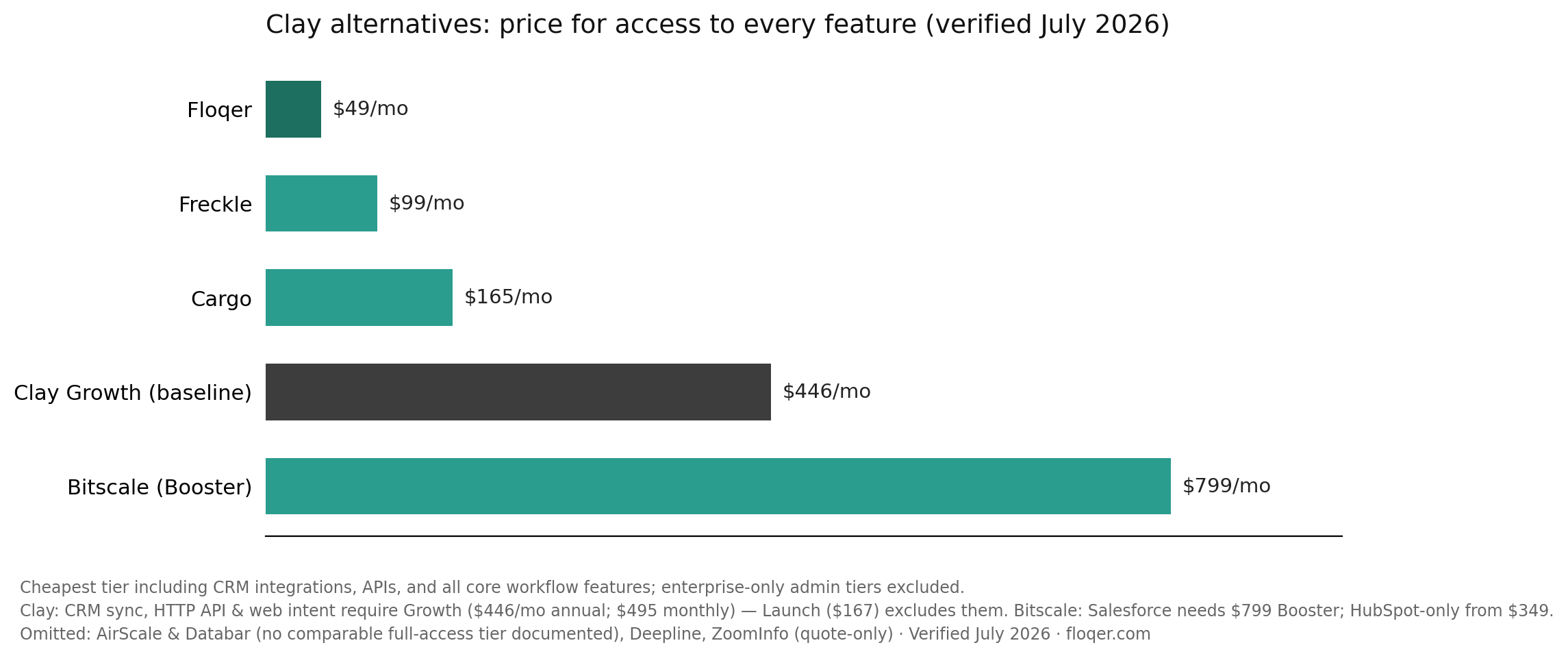
Entry price buys different products. Floqer, Freckle, and Cargo ship their full feature set on every plan, while Clay gates CRM sync, HTTP APIs, and web intent behind Growth ($446/month annual, $495 monthly) and Bitscale gates Salesforce behind its $799 Booster tier.
One caveat before you compare those numbers: a credit is not a standard unit. Every vendor decides what a credit buys, and what counts as billable at all. Some charge only when a lookup returns a valid result, some bill every workflow step, some price a phone number at five times an email. So credits-per-dollar comparisons across tools are directional at best. What matters is cost per result you actually need, on your data mix. Price the plans against a real list before you switch.
How we evaluated and verified every tool
Four rules governed this list:
The inclusion test. Clay is an orchestration layer, not a database: multi-provider waterfall enrichment plus flexible workflows. A tool made this list only if it replaces that whole combination (the three full platforms) or covers the enrichment core with less depth (the five lightweight tools). Email sequencers, single-source databases, and discontinued products were cut and are listed separately, with reasons.
Price verification. Every price was pulled from the vendor's own public pricing page on July 12, 2026. Where a vendor publishes no pricing (ZoomInfo), we used third-party estimates and labeled them as estimates. If we couldn't confirm a vendor's figures against an independent source, the tool was excluded entirely (see the note on exclusions at the end).
Sources. Vendor pricing pages and documentation, RevOps and GTM-engineering communities (r/revops, r/gtmengineering, r/coldemail), and public case studies. Where independent validation is thin, as it is for several of the younger tools on this list, the tool's entry says so plainly instead of omitting it.
What we haven't done yet. We have not run a hands-on, same-list benchmark across these tools. Everything above comes from verified pricing pages, vendor documentation, and third-party reporting, and when that changes, the results will be published on this page.
Why teams leave Clay: 3 reasons
Clay reviews and RevOps communities on Reddit repeat the same three complaints:
- Credit costs, and the pricing Clay recently launched. Clay recently launched a new pricing model in March 2026 that split usage into Data Credits (third-party data lookups) and Actions (every workflow step: enrichment, AI calls, HTTP requests, CRM pushes). Actions get consumed even when you bring your own API keys, a cost layer that didn't exist before. Launch is $167/month billed annually ($185 monthly) for 2,500 Data Credits, Growth is $446/month for 6,000, and multi-step workflows burn both fast. RevOps communities on Reddit put it bluntly: the credit model taxes the exact motion that makes outbound work. Teams on older, grandfathered plans also report that new features increasingly require moving onto the new pricing. And the sticker price understates it: CRM sync, HTTP APIs, and web intent are not on Launch at all (they require Growth), so full-featured Clay is a $446-a-month product ($495 billed monthly), not a $167 one.
- It is hard to use, and needs a dedicated operator. Clay has a real learning curve. Most teams don't see an enriched row for hours while they build, and the teams that get value from it staff a Clay operator or GTM engineer to own it. If nobody owns it, the tables rot.
- Workflow flexibility hits a ceiling. Clay's spreadsheet-style tables are strong for linear enrichment, but they are not built for the branching, split-path agentic workflows you would wire up in n8n, and they give you little control over caching and re-runs. There is also a hard 50,000-row cap per table on every non-Enterprise plan, so large lists force teams to split data across tables or rebuild them, with unlimited rows only on Enterprise. This ceiling, more than data coverage, is what most teams actually run into. Clay's data is aggregated from providers rather than owned, but that is rarely the real reason people leave.
What counts as a Clay alternative
Clay is not a database. It's an orchestration layer: a spreadsheet-style workspace that runs waterfall enrichment across 100+ data providers, adds AI research agents for unstructured questions, and pipes results into your CRM and outbound tools. A real alternative replaces that whole combination: multi-source data plus flexible workflows. An email sequencer doesn't. A single contact database doesn't. That one test eliminates most tools on most lists.
The 3 full Clay alternatives (enrichment + workflow platforms)
1. Floqer: for teams without a dedicated Clay operator
Floqer is the managed, AI-native alternative to Clay. You get the same core: 100+ data sources with waterfall enrichment, 80+ buying signals (funding, hiring, website visits, search intent, G2 and Reddit mentions), an AI research agent, and 10+ CRM connectors. The difference is that Floqer builds and runs those GTM motions for you instead of handing you a blank canvas, and that shows up as time to value. Perplexity's team built an end-to-end enrichment workflow in a few hours, then captured roughly 75,000 social-listening leads inside a month, while cleaning and enriching 10M+ records and generating millions in qualified pipeline from Floqer-sourced leads (case study). Trolley mapped its TAM, doubled demos booked, and built a seven-figure SQO pipeline in three months (case study).
Clay expects you to build. Floqer ships one-click workflow apps for the common GTM plays: inbound enrichment, website visitor follow-up, CRM refresh, signal-triggered outreach. On enterprise plans, Floqer's team builds and manages the workflows for you. It's enterprise-grade (SOC 2 Type 2, GDPR, SSO) and runs at enterprise volume, with customers including Perplexity, Wise, and DXC.
On price: Floqer runs $49/month (2,000 credits) to $999/month (80,000 credits), with unlimited seats on every plan, bring-your-own API keys, and unlimited credit rollover. The model is deliberately narrow: you pay for the infrastructure and the usage, with no per-seat fees and no feature gates on the core platform, so the whole team can build and run on one shared balance. That last point matters more than it sounds. Most tools cap how many credits carry over (Clay and Freckle at 2x monthly credits, Bitscale at 3x), while Floqer lets credits roll over with no cap for as long as your subscription is active. Clay's Launch is $167/month billed annually ($185 monthly) for 2,500 Data Credits, priced per workspace, with a separate Actions meter on top and rollover capped at 2x.
Best for: teams that want waterfall enrichment and workflow automation without dedicating headcount to it, from lean startups to enterprises. EMEA-heavy teams too: customer Azumuta went from 16% to 66% enrichment coverage after switching.
Who should NOT pick Floqer: teams whose main job is running ad campaigns. Floqer does not run ad campaigns natively today; it connects to ad platforms over HTTP APIs, but there is no native ad functionality yet, so for native ad campaigns Clay is the better pick. Builders, on the other hand, are not the reason to look elsewhere: Floqer handles the branching, split-path flows Clay's tables are not built for. Floqer is also younger (founded 2024), and Clay's template community is larger.
Pricing: free plan (100 credits); $49 to $999/month at floqer.com/pricing.
Clay vs Floqer in one line: same category, but Floqer lets you build the workflow or have it run for you, on unlimited seats with unlimited credit rollover and a 3x cheaper entry; Clay keeps the bigger template community and native ad campaigns.
2. Cargo: for technical GTM engineers with warehouse stacks
Cargo is revenue orchestration for teams that think in systems, not spreadsheets. It connects to your data warehouse, runs enrichment and AI agents across 100+ integrations, and doesn't gate features by plan. You pay for usage.
Best for: RevOps and GTM engineering teams that want GTM logic living next to their data infrastructure.
Weaknesses: it raises Clay's skill requirement rather than removing it, and per-credit cost ($0.25) is on the high end.
Pricing: from $165/month (1,500 credits) to $3,000+/month.
Clay vs Cargo in one line: Clay is a spreadsheet for operators. Cargo is infrastructure for engineers. Pick by who on your team will own it.
3. ZoomInfo GTM Studio + Copilot: the enterprise route
ZoomInfo rebranded in May 2025 as the Go-To-Market Intelligence Platform. GTM Studio (campaign data workflows) and Copilot Workspace (AI agents for research, follow-ups, CRM updates) are its direct answer to Clay. Both run on data ZoomInfo owns, with the compliance posture enterprise procurement requires.
Best for: teams already using ZoomInfo that want to add Clay-style workflows on data they already license and stay inside one governed ecosystem, rather than adopt a new aggregation layer. It rarely makes sense as a fresh purchase just to replace Clay.
Weaknesses: no public pricing. Third-party estimates put realistic costs at $15k to $40k+/year. Auto-renewal clauses with 60 to 90 day cancellation windows are a well-documented complaint. Single-source data is the coverage problem waterfalls exist to solve.
Pricing: quote-only; budget $15k+/year minimum (estimates, not vendor figures).
Clay vs ZoomInfo in one line: Clay aggregates many providers on usage pricing. ZoomInfo runs Clay-style workflows on its own governed database, and it makes most sense if you already pay for ZoomInfo.
The 5 lightweight Clay alternatives for smaller teams
These cover Clay's core job, spreadsheet-style enrichment across multiple providers, with less depth and a lower bill. For a 2 to 10 person company, that trade is usually the right call.
AirScale: budget list building and waterfall enrichment
AirScale sources leads and runs waterfall enrichment across 30+ providers, and you only pay when valid data is found. Unlimited seats and credit rollover on every plan. It also carries an AI research agent (Airsearch), hiring and job-change signals, intent-based sourcing, and now runs from ChatGPT or Claude over MCP, so it is more than a plain list cleaner. What it is not is a full workflow-automation platform: no always-on, signal-triggered orchestration like Clay or Floqer. Its headline credit rate is the lowest on this page, but AirScale credits don't buy the same work as Clay or Floqer credits, so that number is directional, not a like-for-like discount.
One thing buyers should know: AirScale can connect to your own LinkedIn and scrape lists straight from a Sales Navigator search, PhantomBuster style. That path needs your own Sales Navigator subscription and a Chrome extension that reads your LinkedIn session cookie, capped at 2,500 leads per search. Some teams want exactly this. Others avoid cookie-based scraping, because pushing volume through your own account carries LinkedIn restriction risk. You can also build lists without LinkedIn using the Leads Finder, company search, Google Maps, and CSV import. Young company, near-zero third-party reviews so far.
Pricing: $49/month (4,000 credits) to $189/month (25,000).
Clay vs AirScale in one line: AirScale is cheaper on paper and adds native Sales Navigator sourcing off your own LinkedIn. Clay and Floqer give you the deep workflow automation AirScale doesn't.
Bitscale: Clay-style features, mid-market pricing
The closest functional clone of Clay in this tier: waterfalls across 100+ providers, AI agents, GTM playbooks, two-way HubSpot sync, and credits spent only on valid results. Its cost edge over Clay is on running spend: every paid plan includes unlimited actions, so you don't pay per workflow step the way Clay's 2026 model does, and at $349/month for 15,000 credits its headline credit rate sits well below Clay's Launch, though the two don't define a credit the same way. The trade-offs are concrete. Entry is $349 versus Clay's $167, so it pays off at volume, not on day one. The integration surface is narrower than Clay's long tail, and the pieces that matter most are gated by tier: two-way HubSpot comes with Growth, Salesforce needs the $799 Booster tier, and Snowflake pipelines, custom CRM integrations, SSO, and role-based access are Enterprise-only, starting at $15k a year. The free plan reaches only 10+ data sources against 100+ on paid. Unlimited actions is real, though action columns per grid are capped at 30 on Growth and 50 on Booster. Independent validation is thin so far.
Pricing: free (200 credits); paid from $349/month (about $314 on annual billing).
Clay vs Bitscale in one line: near-identical feature set to Clay. Bitscale wins on cost per credit and unlimited actions; Clay and Floqer both start cheaper, and Clay keeps the bigger template community.
Freckle: lightweight CRM enrichment for HubSpot and Salesforce
Freckle is the most lightweight tool in this tier, and that is the point. Describe what you want in plain English and its AI agents enrich records from the open web and around 40 to 50 data providers, with native HubSpot and Salesforce sync on every plan including the free one. It handles incomplete records well, finding what you need even from just a personal email. Freckle itself says it is built for non-technical users who find Clay hard, with less workflow configurability by design, so it is not for agencies or large RevOps teams running complex logic. It also carries fewer data providers than the heavier tools here, a narrower integration set focused on CRM, and the highest headline credit rate in this tier (one credit is one output, and a phone number costs five). Scope is the real limit. The use cases are narrow enough that it lands closer to a waterfall specialist like FullEnrich than to Clay's full workflow scope. The trade is simplicity: quick enrichments with no setup. Seed-stage (raised $4M in 2025, 3,000+ teams).
Pricing: free (500 credits/month); paid from $99/month (2,500 credits), up to $6,250/month (250,000 credits).
Clay vs Freckle in one line: if you want quick CRM enrichment with no setup, Freckle does it in minutes; for complex workflows or heavy provider coverage, Clay and Floqer have the room Freckle doesn't.
Databar: no-code grid over an API marketplace
Structurally the closest thing to Clay's grid in this tier: a no-code spreadsheet over 120+ data providers with web scraping, batch enrichment, and scheduling. Watch two things: third-party testing reports inconsistent phone-data accuracy, and plans jump from $99 to $495/month with nothing in between.
Pricing: from $99/month (5,000 credits).
Clay vs Databar in one line: the same grid concept at half the entry price, minus the AI research depth and workflow maturity you get from Clay or Floqer.
Deepline: AI-native, API-first data layer (early)
Deepline is an agent-native data layer: one API and CLI over 97+ GTM integrations, driven by AI agents, with results in a Postgres database you own. Bring your own provider keys and the platform fee is zero. It is early and unproven, with minimal reviews and no public funding history, so it suits AI-native teams comfortable working against an API, not general GTM users. Enrich.so is a comparable API-first waterfall if you want something in the same shape.
Pricing: free with your own API keys; usage-based otherwise; $395/month managed tier.
Clay vs Deepline in one line: Clay is built for humans in a spreadsheet and Deepline for AI agents in a terminal; Floqer runs both ways, through apps or its MCP server and headless API.
Which Clay alternatives work at enterprise scale?
Not every tool here runs at enterprise volume, and pretending otherwise wastes your time. Four do.
Floqer and ZoomInfo GTM Studio are built for enterprise revenue orgs: security reviews, procurement support, managed onboarding, and throughput that holds at high volume. If you go the patchwork route, Gumloop and n8n also operate at enterprise scale. n8n ships a self-hosted enterprise edition with SSO and audit logs, and Gumloop sells enterprise plans, though with both you still supply the GTM data and logic yourself.
The rest are younger companies. AirScale, Bitscale, Freckle, Databar, and Deepline are solid for small and mid-market teams that don't need security documentation or a long procurement process, but they are not yet proven at enterprise volume. Don't expect enterprise SLAs or guaranteed high-throughput enrichment from them today.
Is Apollo a Clay alternative?
Not a complete one yet, but closer than it used to be. Apollo shipped multi-provider waterfall enrichment in December 2025 (out of beta, 18 data providers, all paid plans), and in 2026 it added waterfall enrichment at the point of CSV upload, so table-style enrichment works now too. That erases the old disqualifier. What Apollo still lacks is Clay's orchestration layer: flexible research columns and the multi-step workflows that make Clay a build-anything platform. Apollo enriches and sends. It doesn't orchestrate. Reviewers still flag accuracy gaps on its native single-source lookups, though the waterfall reduces that.
Clay vs Apollo in one line: Apollo now does waterfall and table enrichment, so it covers the data job, but it replaces Clay only if you don't need custom workflow orchestration.
Can you replace Clay with Gumloop, n8n, or pipe0?
You can assemble a patchwork version. Use Gumloop (general AI workflow builder, from $37/month) or n8n (from €20/month, free self-hosted) for orchestration, plus your own API keys for data providers. pipe0 is a closer visual match: a "Sheets" view built specifically as a 1:1 Clay-style alternative, and generally cheaper than Clay. But with the general builders, neither ships data of its own, and GTM is not Gumloop's specialty. You'll wire every provider, handle every error state, and maintain it forever. That's not a Clay alternative. That's becoming Clay, unpaid. If what you actually want is n8n-style split-path workflows with GTM data already in them, that is Floqer's shape: 100+ sources, waterfalls, and signals wired in, from $49/month with unlimited seats. The patchwork's sticker price is lower, but you pay the difference back in provider subscriptions and maintenance time.
What switching from Clay actually costs
Switching from Clay has four real costs. Rebuild time: Clay tables, formulas, and waterfalls don't export into another tool's logic, so budget a day or two to recreate the plays you use (most teams find it's three or four, not thirty). Maintenance tax you're leaving behind: reviewers on r/gtmengineering and r/revops describe multi-hour debugging when a provider changes its API or deprecates a field. A managed tool absorbs that server-side, and that's often the real reason to switch. Data continuity: B2B contact data decays 26 to 35% a year by role, so migration is a chance to re-verify a stale list, not just move it. Contract overhang: on annual Clay billing, time the switch to your renewal, and watch auto-renewal windows on whatever you move to (ZoomInfo's 60 to 90 day clause is the cautionary tale). Tools with unlimited seats and month-to-month terms, like Floqer and AirScale, carry the least switching risk.
Tools that are not Clay alternatives
Email sequencers (Instantly, Smartlead, lemlist, Outreach, La Growth Machine): they send email, and La Growth Machine adds LinkedIn and multichannel steps. Teams pipe Clay or Floqer output into them. Complements, not substitutes.
Contact databases and finders (Lusha, Cognism, Hunter, Kaspr, UpLead, LeadIQ, Lead411, Seamless.AI, RocketReach, Snov.io, Wiza, Prospeo, Findymail, Crustdata): these are data providers, several of which are sources inside Clay's and Floqer's waterfalls. An ingredient is not an alternative to the recipe. Cognism earns a specific note: excellent GDPR-compliant EU phone data, but still a single source. Use it inside a waterfall, not instead of one.
Waterfall enrichment specialists (FullEnrich, BetterContact): they replicate Clay's enrichment slice cheaply, but with no workflow layer, signals, or AI research.
Discovery and signal tools (Ocean.io, Exa Websets, RB2B, Trigify, Warmly): lookalike discovery, AI-native search, visitor identification, social listening. They produce the accounts and leads you'd then enrich and route in a Clay or Floqer workflow.
Browser and automation agents (Bardeen): general-purpose scraping and automation. It can move data around, but it ships no GTM data and no enrichment waterfall. It's closer to the Gumloop/n8n patchwork than to Clay.
AI SDRs (11x, Artisan, AiSDR, Coldreach): they aim to replace the salesperson, not the data and workflow layer.
HubSpot Breeze Intelligence (formerly Clearbit): standalone Clearbit was sunset after the HubSpot acquisition. What remains is single-source, company-level enrichment locked inside HubSpot, and it isn't purchasable standalone.
When Clay is still the right choice
Stay on Clay if you have a dedicated GTM engineer who's productive in it, you rely on its template community and long integration tail, or you're an agency building custom data operations for clients. Clay's real advantages are maturity and ecosystem: the largest template library in the category, the longest tail of integrations, custom JavaScript and webhooks inside its table model, and native ad campaigns most alternatives don't run. Most teams never use enough of that to justify the bill.
FAQ
What is the best Clay alternative in 2026? Floqer, for most teams. You get multi-provider waterfall enrichment plus workflow automation from $49/month with unlimited seats, and you don't need a dedicated operator. ZoomInfo GTM Studio for teams already on ZoomInfo.
What is the cheapest Clay alternative? Floqer and AirScale both start at $49/month, the lowest entry price on this list, against Clay's $167. AirScale's plan carries more nominal credits, but credits aren't a common unit across vendors, so price both against your real data mix. At that same $49, Floqer includes workflows, signals, unlimited seats, and unlimited rollover; AirScale is list-building and enrichment only.
Is there a free Clay alternative? Free tiers exist for Floqer (100 credits), Freckle (500 credits/month), Bitscale (200 credits), and Deepline (free platform with your own API keys). Sustained volume needs a paid plan anywhere, and the lowest paid entry on this list is $49, from Floqer and AirScale, against Clay's $167.
Did Clay raise prices in 2026? Clay recently launched a restructured pricing model in March 2026. It collapsed its self-serve tiers into Launch and Growth and split usage into Data Credits (third-party lookups) and Actions (workflow steps, AI calls, HTTP requests, CRM pushes). Launch is $167/month billed annually ($185/month monthly). Here's the catch teams noticed: Actions get consumed even when you use your own API keys, which adds a cost layer that didn't exist before. It's the main reason teams started shopping, and the ones who move tend to pick models without a second meter stacked on top: Bitscale includes unlimited actions on paid plans, and Floqer bills a single credit unit with unlimited rollover instead of separate credits and actions.
Is there a Clay alternative that doesn't need workflow building? Floqer ships one-click workflow apps for common GTM plays: inbound enrichment, CRM refresh, signal-triggered outreach. You get automation without building on a blank canvas. For pure list-building with no orchestration at all, AirScale enriches an uploaded list across 30+ providers.
What is the best enterprise Clay alternative? Floqer and ZoomInfo GTM Studio, both with security reviews, procurement support, and high-volume throughput. Gumloop and n8n also work at that scale if you want to build the workflow yourself.
Is Apollo.io a Clay alternative? Not a complete one. Apollo added multi-provider waterfall enrichment in December 2025 and table-style enrichment on CSV upload in 2026, so the data gap has narrowed. It still lacks Clay's workflow orchestration: flexible research columns and multi-step workflows.
What happened to Persana AI? Rox acquired it. Billing stopped April 1, 2026, and remaining customer data was deleted May 2, 2026. Any list still recommending it is out of date.
What do RevOps communities recommend instead of Clay? Reddit's r/revops, r/gtmengineering, and r/coldemail threads converge on the same pattern as this page: Apollo for cheap all-in-one outbound, Cognism for EU phone data, and Floqer as the workflow platform when the complaint is Clay's credit costs, complexity, or the operator it takes to run it. The same story shows up in Floqer's G2 reviews: teams that didn't have time to learn Clay, switched, and recommend it.
Is Clay worth it in 2026? Yes, if you have a dedicated operator and use its depth. If you're paying $167 to $446/month plus Actions and Data Credits and your tables sit unmaintained, a managed or lighter alternative will return more. Floqer covers the same job from $49/month with unlimited seats and no operator required.
Published by the Floqer team.
We build one of the tools on this list. Every price above was verified against the vendor's public pricing page on July 12, 2026. Estimates are marked as estimates.
A note on what we left out. Some tools that appear on other lists, including Cleanlist, were considered but excluded because their pricing and performance figures are self-reported and we couldn't confirm them against an independent source to the same standard as the tools above. We'd rather leave a tool off than publish a number we haven't verified. If that changes, we'll add it.